
It's 11pm. You're on your phone, posting the reel you filmed this morning, copying the same "here's the link!" reply into the fourth DM today, telling yourself you'll finally set up that welcome email this weekend. The weekend comes and that welcome email gets buried, because it's sitting behind client work and invoicing and the twelve other tasks that live permanently on a founder's to-do list. So you're back here next Tuesday at 11pm doing all of it again.
Every founder I work with hits the same wall, and most of them say some version of the same sentence to me: "I know I'm supposed to use marketing automation, but I have no idea where to start, and honestly I'm scared it'll make me sound like a robot."
I get the fear. You built your business on being a real person who actually cares, and the word automation sounds like the opposite of that. But you're scared of the wrong part. Done right, marketing automation doesn't make you less personal. It gives you back the hours you're currently spending on busywork so you can be MORE present where it actually counts. Let me show you what's safe to hand off, what to keep, the actual tools to use, and the first step to set each one up.

Marketing Automation Feels Cold Only When You Automate the Wrong Thing
There's a difference between automating the relationship and automating the logistics.
Nobody wants their actual client conversations, their real replies, their genuine "I saw your post and thought of you" moments run by a machine. That's the relationship, and it stays yours forever. But the mechanics around it? The posting, the sending, the link delivery, the reminder that goes out whether or not you remembered? None of that needs your warm human hands on it. A scheduled post doesn't feel less sincere to the person reading it. They have no idea you set it up two weeks ago in your pajamas.
So the goal was never to automate YOU. It's to automate the forty small logistical tasks standing between you and the people you're trying to reach, so you have the energy left to actually reach them.
How to Decide What Marketing to Automate First
Skip the twelve-tool tech stack for a second. Before any tool, run every task through one question: is this repeatable, and does it need my judgment or my voice every single time?
If something happens the same way over and over AND doesn't require your brain fresh each time, automate it this week. The welcome email every new subscriber should get. The link you send every time someone comments a keyword. The post that goes out Tuesday at 9am no matter what. That stuff is pure logistics, and you doing it by hand is just you being a very expensive robot.
If something genuinely needs your thinking or your voice each time, keep it human for now, or document your voice well enough that a person or a tool can carry it for you. Repeatable and brainless gets automated. Judgment and voice stay with you, or get systematized carefully.
If this is making you realize how much is still sitting on your plate, let's talk. Book a free 15-minute call and I'll look at what it would take to get it off of it.
Automation #1: Scheduling Your Content
Start here, because if you're still posting live from your phone every single day, you're chained to the app, and that's the fastest chain to cut.
Sit down once, build a week or a month of content in one session, schedule it all, and then close the app and go live your life while it posts without you.
For tools, you've got options at every budget. Meta's own Business Suite is free, and if funds are tight it's a solid place to start, it schedules your Instagram and Facebook posts straight from the source. I'll be honest, Meta can be clunky and occasionally maddening, so if you have a little room in the budget, Later and Metricool are both easier to use, let you see your whole month on a visual calendar, and handle more platforms. Any of the three works.
The first step is the same regardless: pick one, connect your socials, and schedule just next week's posts to start. That one move buys back the daily "oh no I haven't posted" panic immediately.
Automation #2: Instant Delivery With a Keyword
You know how creators say "comment WORD and I'll send you the link"? That's a DM automation. You set it up once so that any time someone comments a specific word on your post, they instantly get a direct message with your freebie, your booking link, whatever you're pointing them to. It fires at 2pm or 2am, whether you're working, sleeping, or on vacation, and every single person gets an immediate response instead of waiting for you to see it.
The tool for this is ManyChat, which connects to your Instagram and runs the whole system. To set up your first one: pick one offer worth clicking (a free guide, a quiz, your call link), choose a keyword that matches it, and build a simple two-message flow, one that greets them and confirms they want it, and one that delivers the link. Then make a post telling people to comment that word. You'll watch it work in real time and wonder why you spent a year copy-pasting links by hand.
Automation #3: The Email Welcome Sequence
This is the one almost everyone skips, and it's the highest-leverage automation on the list.
A welcome sequence is a short set of emails, usually three to five, that send automatically in order the moment someone joins your email list. You write these four or five emails one time, and they keep greeting every new subscriber for months without you touching them again, introducing you and your work while you're asleep or with your kids or doing literally anything else.
Here's a simple version you could build this week:
Email 1 (sends immediately): welcome them, deliver whatever they signed up for, and tell them who you are in two lines.
Email 2 (a day later): your story, why you do this work and who you help.
Email 3 (two days later): your best free advice on the exact problem they came to you for.
Email 4 (a few days later): a soft invitation to work with you or buy something small.
That's four emails quietly warming up a stranger into someone who knows, trusts, and is ready to buy from you, all on autopilot.
You build this inside an email platform like Mailchimp, Flodesk, or Kit (most have a free tier to start). The feature you're looking for is called an "automation" or a "sequence," not a "campaign,"
Content Repurposing Is Where the Hours Actually Hide
Content repurposing changes the math entirely, and it's where AI finally earns its keep in your marketing.
Most founders think using AI means handing a blank page to a machine and hoping it sounds like them. It won't, and that's the stuff that reads like a robot wrote it. The real move is content repurposing. You take ONE piece you already said in your own voice, a talking-head video, a long caption, a story you told on a call, and you reshape it into a week of content. The blog becomes an email. The email becomes three posts. The posts become a carousel. You said it once. The system helps you say it ten more ways.
In practice, this looks like taking a transcript of a video you recorded, dropping it into a tool like ChatGPT or Claude, and asking it to pull out three post hooks, an email, and a carousel outline from what you already said. The catch, it only works if you feed it your actual words first. Automation amplifies whatever you give it. Put in something generic and you get louder generic. Put in your genuine take and it stays unmistakably you across every format. The machine isn't the writer. You're the writer. It's the multiplier.
Having a clear message dialed in before you automate anything matters so much. If you're not yet sure what your core message even is, you'll just be scaling confusion. I walk through building that exact foundation in my masterclass, picking your lane and your message so everything you repurpose is pointed in one direction. It's the first move I'd make before touching a single automation tool.
You're the Bottleneck, Not the Secret Ingredient
Somewhere along the way you started believing that if you're not personally touching every piece of marketing, it won't be any good. That the magic is you, doing it all, by hand. I understand the instinct. But doing everything manually doesn't make your marketing better. It makes YOU the reason your business can't grow past the hours in your day. The work piles up behind the one bottleneck in the whole operation, which is you at 11pm on your phone.
Trusting a system feels like letting go of quality. It's actually the opposite. A good marketing system holds your standard steady even on the weeks you're slammed, sick, or just done. It runs on your worst day, which is exactly the day your old all-by-hand method falls apart. Built right, around your real voice and a clear plan, automation doesn't dilute you. It protects your consistency when your willpower taps out.
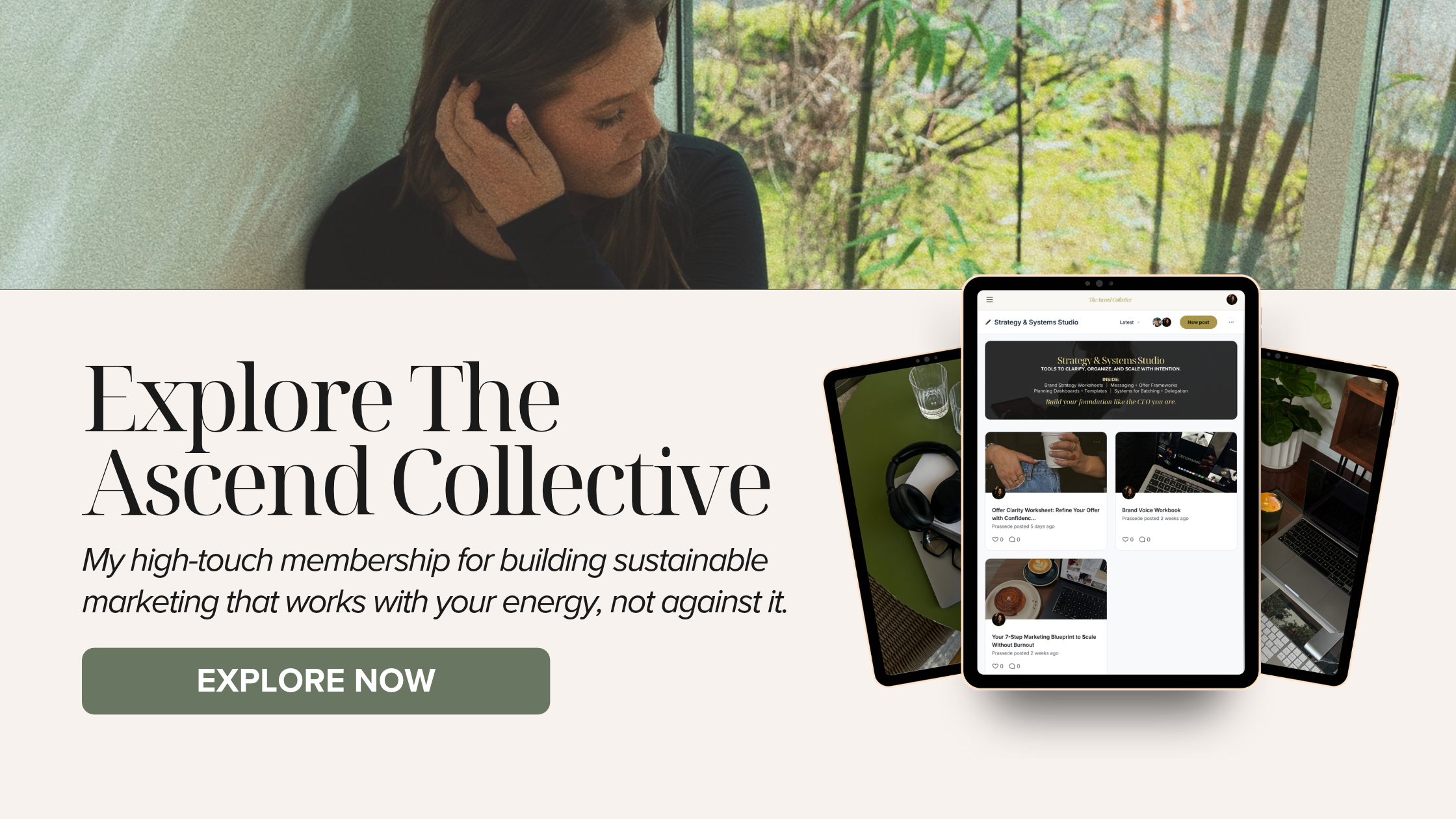
That strategic layer, deciding what to automate, setting it up around your voice, and actually trusting it, is the whole thing I help founders build inside The Ascend Collective. It's where the systems get set up with real strategy underneath them instead of you duct-taping tools together alone at midnight. If you're ready to stop being your own bottleneck, come build it with me.
The best time to set up your marketing automation is right now, before the end-of-year rush, not in the middle of it. Spend a few hours building the systems this month and your December self gets to actually enjoy the holidays while your marketing keeps running without her.
So here's the honest question: how many of the tasks you'll do by hand this week could a system have handled while you slept? Start with just one. That one is how you get your first evening back.