
Most people plan their new year by deciding to post more. More reels, more platforms, a shiny new content calendar they’ll abandon by February. I want to talk you out of that before you waste another year of effort on it.
Volume was never your problem. I’ve reviewed hundreds of business owners’ accounts, and the ones that quietly book clients all year aren’t posting the most. They have the right pieces in place, the specific content that does the actual selling so the business owner isn’t personally re-explaining their value in every DM and discovery call. That’s what you build before January. Not more content. Conversion content.
So let me give you the actual checklist, the five kinds of content worth building before 2027, what each one does, and how to make yours.

Why This Matters Before January, Specifically
People rarely buy from you the day they discover you, whether you sell a service or a product. You already know this from your own business. Someone finds you, lurks for a while, and then reaches out months later when the timing finally lines up for them. That long stretch in the middle is where the trust gets built or lost.
January is when a huge wave of your future clients start that clock. New year, new budget, new “okay, I’m finally dealing with this” energy. If the content that answers their quiet objections and proves you’re the real deal isn’t already sitting there waiting for them, you miss the window while you’re still scrambling to make it. The goal is to have your conversion content live before the people looking for it show up, not three weeks after.
If you want help building the actual plan behind all of this, picking your lane and mapping it to a real 30-day rhythm, I recorded the exact framework I teach my clients inside my masterclass. It’s the fastest way to turn “I should really get organized for next year” into a plan you’ll actually run.
1. FAQ Content
Who it’s for: every business, because every business gets asked the same handful of things over and over.
Make content that answers the questions people ask before they buy, plus the ones they’re too polite to ask out loud. How does the process work. What does it cost, roughly. How long does it take. What happens on the first call. The questions that live in your inbox and your consults are the exact questions keeping silent prospects from reaching out at all.
Why it converts: every unanswered question is a small reason to wait, and “I’ll look into it later” is where most sales quietly die. When you answer these in public, you remove the friction before someone even has to ask, and you look like the organized, trustworthy option while you’re at it. A roofer who has clearly answered “how do I know if I actually need a new roof” is the roofer people call when the ceiling starts dripping.
Make yours: open your sent folder and your DMs, pull the ten questions you answer most, and make one piece of content for each. That’s ten posts, already written by your own clients.
2. Objection-Handling Content
Who it’s for: anyone whose prospects hesitate, which is all of us, especially at higher price points.
This is the slightly braver cousin of the FAQ. Instead of logistics, you name the real reasons people stall. “It’s too expensive.” “I think I can figure this out myself.” “I’m not sure this is right for someone like me.” “Now’s not a great time.” You say the quiet objection out loud and then speak to it honestly.
Why it converts: the objection a buyer never voices is the one you can’t answer, because the conversation never happens. . They just silently decide no. Content that names the hesitation does the hardest part of selling for you, at scale, before anyone books a call. It also builds a strange kind of trust, because you clearly aren’t afraid of the hard questions.
Make yours: write down the three objections you hear most, and the one you suspect people think but never say. Make a piece for each that respects the concern instead of steamrolling it.
3. Transformation Stories
Who it’s for: business owners selling an outcome, which is most of you.
Tell the story of a client’s before and after. Where they started, what was actually going wrong, what changed, where they landed. You can keep it anonymous. The specifics are what matter, not the name. I had a client come to me with a beautiful Instagram grid and zero inquiries, and the fix wasn’t prettier posts, it was finally saying what she actually did in a way people understood. That’s a transformation story, and it sells harder than any list of my credentials ever could.
Why it converts: people don’t buy your product or service, they buy the version of themselves on the other side of it A good transformation story lets a prospect quietly see themselves in the “before” and want the “after.” It’s proof and aspiration in the same piece.
Make yours: pick one client win, and tell it in four beats. The struggle, the turning point, what you did, the result. Real and specific beats polished and vague every time.
4. Social Proof
Who it’s for: everyone, and it’s the one most underused by the people who need it most.
This is testimonials, results, screenshots of a happy client DM, the moment someone said “you explained what I do better than I could.” Not buried on a website testimonials page nobody visits. Worked into your actual feed, regularly, as its own kind of content.
Why it converts: trust is the whole game for high-ticket work, and nothing builds it faster than other people vouching for you A prospect sitting on the fence needs to see that real humans took the leap and were glad they did. One screenshot of a genuine client reaction can do more than a month of you talking about yourself.
Make yours: start screenshotting every kind word a client sends you, today, into one folder. You’ll never remember them later. Then build a simple rhythm of sharing one piece of proof a week.
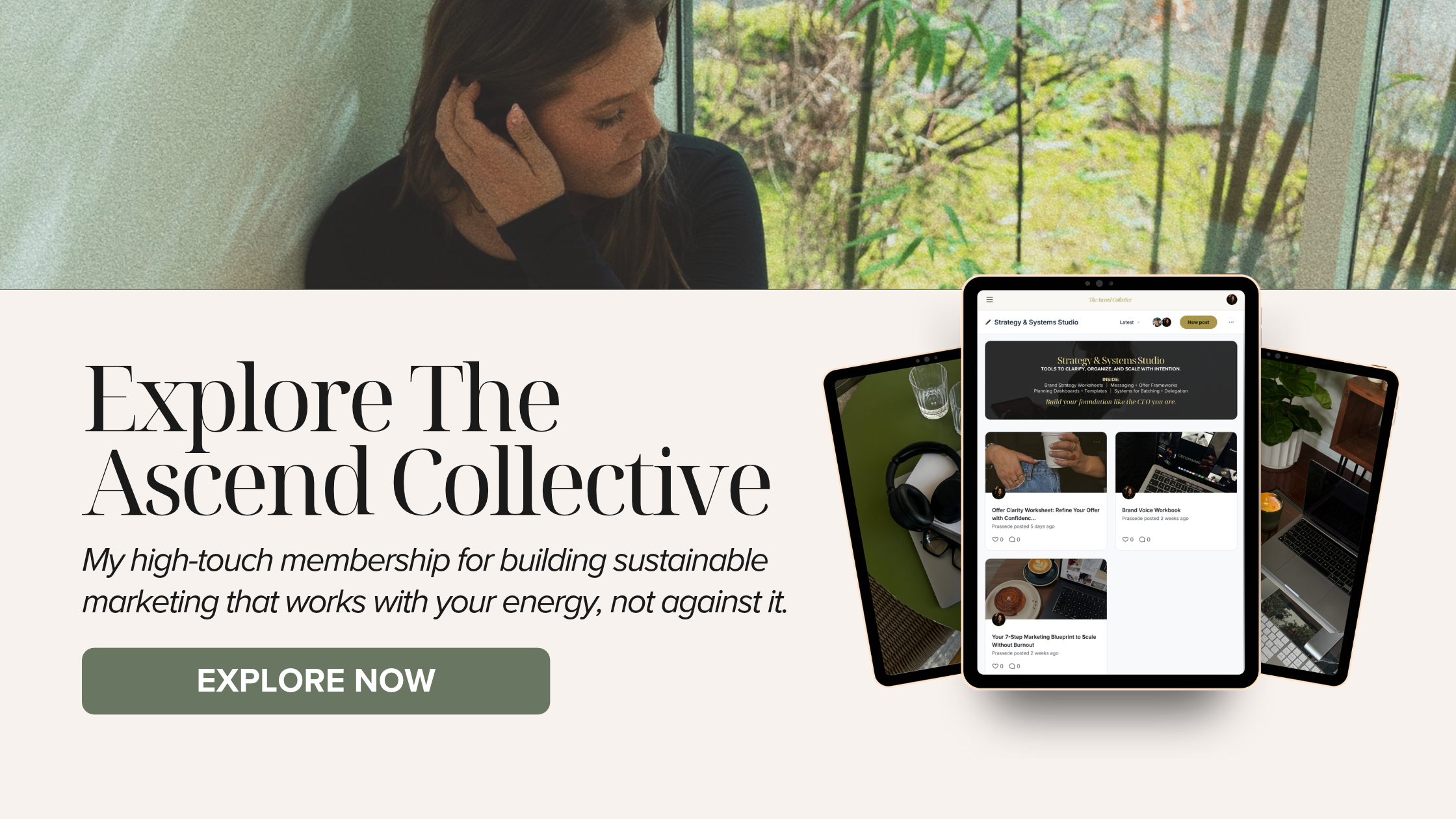
If building all of this from scratch feels like a lot, that’s because it is, and you don’t have to figure it out alone. This is exactly the kind of thing we work through inside The Ascend Collective, where I help you map the conversion content your business actually needs and build it on a rhythm you can keep, with real strategy every week instead of you guessing at it
5. Offer Explainers
Who it’s for: anyone whose audience can’t quite articulate what they sell. That’s more of you than you’d think.
Make content that plainly says what you offer, who it’s for, and how someone works with you. Not clever. Clear. The single biggest thing I see holding accounts back isn’t content quality, it’s that people genuinely cannot tell what the business sells or how to buy it. Your Instagram is a storefront, not a diary, and a storefront with no prices and no “open” sign doesn’t move product no matter how lovely the window display is.
Why it converts: people can’t buy what they don’t understand, and they won’t ask you to explain it. They’ll just move on. Content that spells out your offer, your process, and your next step turns passive followers into people who actually know how to give you money.
Make yours: write one post that finishes these three sentences plainly. Here’s what I do. Here’s who it’s for. Here’s how to start working with me. If that’s harder to write than you expected, you just found the exact gap that’s been costing you clients.
Build It, or Have It Built
Reading this list, you can already feel which pieces you’re missing, and you can also feel how much work it is to build all five well while running the business they’re supposed to support.
If you’d rather not spend your winter writing objection-handlers at 11pm, this is exactly what my team builds for business owners, the full conversion content engine, mapped to your business and your offers, so you walk into 2027 with the pieces already in place instead of on your to-do list. If that sounds like the kind of year you want, book a free 15-minute call and let’s talk about what it would look like for you.
So before you write another content calendar full of posts nobody asked for, build the five that actually sell. Your future clients are already out there, quietly deciding. Give them something worth saying yes to.
So, real question before you plan a single thing for next year: if a perfect-fit client landed on your page today, could they tell what you sell, trust that you’re good at it, and know how to start? If any part of that is a maybe, you just found your 2027 content plan.